
Every association has a calendar.
In fact, we love a calendar.
Board meetings. Renewal deadlines. Annual conferences. Budget cycles. Committee meetings. Education programs. Sponsorship campaigns.
But there is another calendar that may be just as important: the calendar your members are actually living.
Every profession, industry, and community has seasons when its needs become more urgent. For some, those seasons are obvious. For others, they are easy to miss unless you are listening closely.
For government finance professionals, there may be predictable times of year when budgets, audits, reporting, compliance, and financial planning become especially pressing.
For healthcare associations, member needs may shift around clinical cycles, awareness months, school-year routines, patient education needs, or major scientific meetings.
For association executives, there are seasons shaped by board transitions, annual meetings, renewal campaigns, sponsorship planning, legislative activity, and year-end strategy.
For organizations connected to manufacturing, retail, or design, the year may revolve around markets, buying cycles, supply chain issues, consumer demand, and seasonal purchasing patterns.
The point is simple: every association has moments when its value becomes more visible because members are paying closer attention.
Those moments are not just busy times.
They are value moments.
The question is: are we capturing them?
Many associations track key performance indicators. They report on membership numbers, event attendance, sponsorship revenue, open rates, renewal percentages, webinar registrations, certification activity, and financial performance.
That quantitative work matters.
But do we always connect those numbers to the season our members are in?
If webinar attendance spikes in September, do we know why?
If member questions increase in March, do we track what they were asking about?
If sponsors are most responsive during a specific planning window, do we build next year’s outreach around that pattern?
If chapters are more active during certain months, do we plan staffing and communications support accordingly?
If renewal reminders perform better when tied to a professional milestone, deadline, or industry pressure point, do we remember that the following year?
Too often, associations treat these patterns as one-time observations instead of annual intelligence.
A strong staff team may say, “This always happens around this time of year.”
But if that knowledge lives only in someone’s memory, inbox, or post-event recap, it is vulnerable.
People change roles. Staff leave. Board leaders rotate. Committees turn over. Priorities shift.
The association should not have to rediscover the same seasonal patterns every year.
Seasonality should be part of the strategy
Seasonality belongs in the same conversation as OKRs, KPIs, staffing plans, content calendars, and budget planning.
It is not just a marketing insight. It is an operational one.
If you know when members are most likely to need support, you can plan resources before the demand arrives.
If you know when volunteers are most active, you can time leadership asks more thoughtfully.
If you know when sponsors are planning budgets, you can begin conversations earlier.
If you know when members are under the most pressure, you can provide timely tools, templates, webinars, peer discussions, or advocacy updates.
If you know when engagement historically dips, you can adjust expectations, staffing, or outreach strategies.
This is where associations can move from reactive to proactive.
Instead of asking, “What should we send this month?” the better question becomes:
“What season are our members in right now, and what do they need from us because of it?”
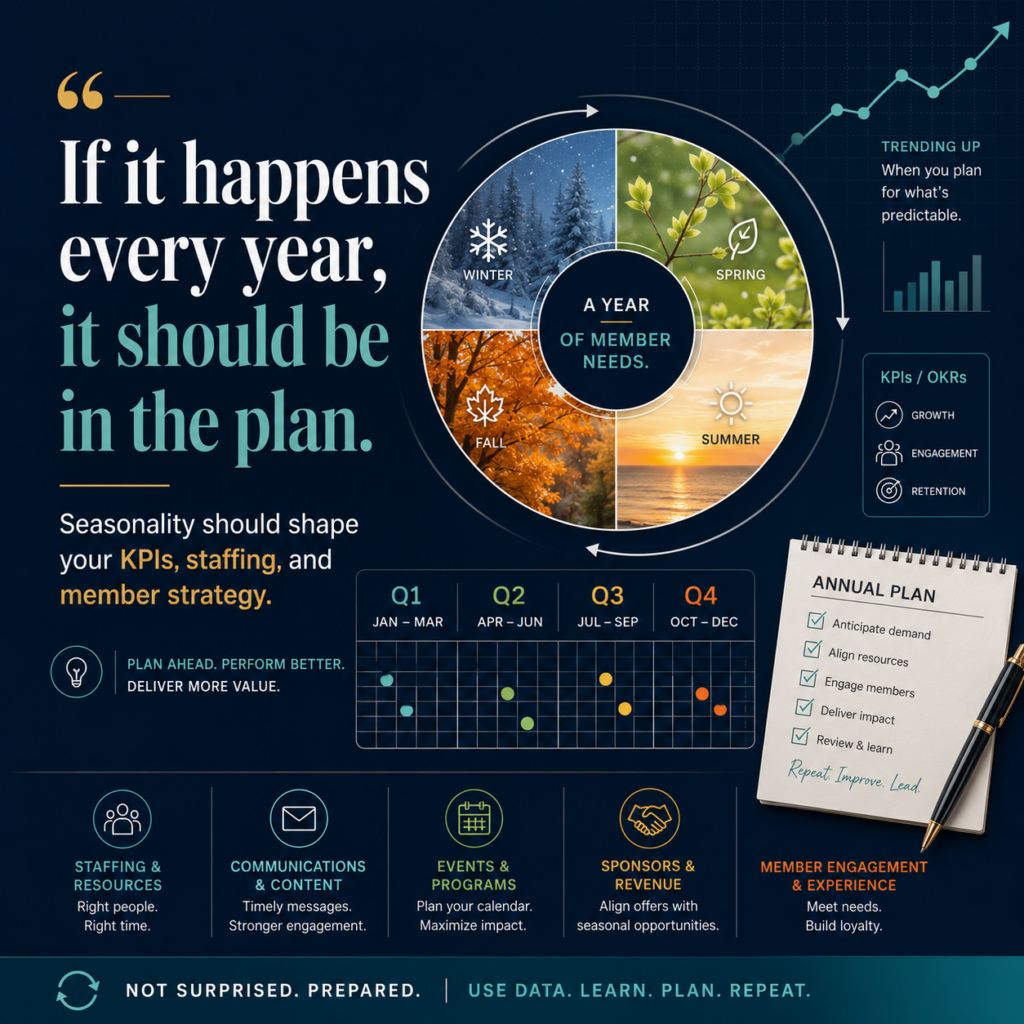
What associations should track
Seasonality does not have to be complicated. Associations can start by capturing a few simple data points throughout the year:
- When do member questions increase?
- What topics come up most often by month or quarter?
- When are members most likely to register for education?
- When are they least likely to respond?
- When do chapters, committees, or volunteer groups need the most support?
- When do sponsors begin planning or renewing?
- What industry deadlines or external pressures affect member behavior?
- When does website traffic spike?
- Which resources are downloaded most often, and when?
- When does staff workload increase, and why?
The key is not just collecting numbers. The key is adding context.
A dashboard that says webinar attendance increased by 20 percent is useful.
A dashboard that says webinar attendance increased by 20 percent because members were preparing for a regulatory deadline is much more valuable.
That is the difference between data and insight.
Make it repeatable
The strongest associations build institutional memory.
They do not rely only on what one staff person remembers from last year. They document what happened, why it happened, and what should be done differently next time.
A simple seasonal trend tracker can help associations answer:
What happens every year?
When does it happen?
Who is affected?
What do members need?
What should we prepare in advance?
What staffing or resources are required?
What should we measure?
What did we learn this year that should inform next year?
This kind of tracking helps associations plan more realistic workloads, avoid last-minute scrambling, and better align staff capacity with member demand.
It also helps boards understand why certain investments are needed. When the data shows that a particular season consistently drives member engagement, staff workload, or revenue opportunity, resource decisions become easier to explain.
Seasonal value moments are member value moments
Associations often talk about proving value. Seasonality gives them a practical way to do it.
Value is not always created by launching something new.
Sometimes value is created by showing up at exactly the right time.
The right checklist before a deadline.
The right webinar before a rule change.
The right peer conversation during a stressful season.
The right reminder before a renewal decision.
The right sponsor opportunity before budgets are set.
The right chapter support before local leaders get overwhelmed.
The right board discussion before planning season begins.
These moments may seem small, but they are often when members feel the association’s relevance most clearly.
A few questions for association leaders
As your team reviews OKRs, KPIs, calendars, and annual plans, consider asking:
- What are the predictable seasons in our members’ professional lives?
- Where do we see annual spikes or dips in engagement, questions, registrations, renewals, or revenue?
- Are we documenting the “why” behind those patterns, or only reporting the numbers?
- What seasonal trends should inform staffing, communications, education, sponsorship, and volunteer support?
- What did we learn this year that we need to remember before this season comes around again?
- Are we planning around our internal calendar, or around the moments when members need us most?
The bottom line
Every association has peak moments when members are paying closer attention because their work, stress, questions, or opportunities are more immediate.
The strongest associations do not wait for those moments to arrive.
They identify them.
They measure them.
They remember them.
They staff for them.
They build content, programs, and support around them.
And most importantly, they use those moments to show members: we understand your world, and we are ready when you need us.