Cutting Through the Noise: How Associations Support Members in a Changing World
Juliet Perrachon
Three Ways Associations Build Trust and Confidence Amid Uncertainty
There’s no doubt about it — the world is changing, and it’s changing fast. Technology is evolving at lightning speed, from artificial intelligence to innovations that reshape how we work. Industries are laying off employees by the thousands, economic conditions shift with little warning, and political uncertainty seems ever-present. These forces create uncertainty across the workforce, regardless of industry.
It’s at times like these that associations play a more than critical role. Associations can serve as a North Star for their industries. When everything around us is changing, people need a place to come together — for strength in numbers, community, and connection. Associations provide a space where members can look to one another for answers and guidance in a world that often feels unpredictable.
“Members want clarity and practical guidance,” says Kim Chhabria, Chief Revenue Officer at NorthStar Association Management. “They’re asking: How will economic shifts, policy changes, workforce challenges, or evolving technologies affect my organization? How are my peers responding? What does “good” look like right now?”
Why Members Are Feeling Anxious
The uncertainty in today’s environment isn’t abstract. It’s operational.
Leaders across industries are navigating rapid technological change, economic volatility, workforce shifts, and policy uncertainty — all at once. The challenge isn’t just the pace of change. It’s the number of moving parts.
Two areas in particular are creating immediate pressure: artificial intelligence and trade policy.
Artificial Intelligence: Moving Fast Without a Playbook
AI is evolving faster than many organizations can comfortably manage.
Members are asking practical questions:
How are our peers approaching this?
Where do we begin?
What guardrails are necessary?
Will AI replace our jobs?
No one wants to fall behind, but no one wants to move recklessly either. That tension creates hesitation. Leaders are not looking for hype; they are looking for clarity and responsible guidance within the context of their industry.
Tariffs and Trade Policy: Real-Time Business Impact
For industries dependent on global sourcing, tariff uncertainty isn’t theoretical; it is directly affecting margins, pricing, contracts, and supply chains.
In sectors like home fashion, members are navigating shifting trade policies that influence sourcing decisions and long-term planning. They’re asking:
How should we price upcoming products?
Do we adjust supply chains?
What are others doing in response?
These are daily business decisions, not policy debates. “Tariffs aren’t just policy headlines for our members, they affect real business decisions,” says Holly Koenig, President of NorthStar Association Management and of HFPA – Home Fashion Products Association. “Companies are trying to figure out how shifting trade rules impact sourcing, pricing, and long-term planning. One of the most important roles an association can play is helping members understand what those changes mean in practical terms.”
Add in workforce shortages, generational shifts, and hybrid work models, and it’s easy to see why many leaders feel stretched.
More than anything, members are seeking orientation. They want to know how broader changes affect them, how their peers are responding, and what “good” looks like right now.
They aren’t just looking for more information.
They’re looking for interpretation.
And that’s where associations matter most.
“Members aren’t looking for more headlines. They’re looking for interpretation — what changes mean for them and how to respond.”
—Kim Chhabria, NorthStar Association Management
The Three Pillars of Steady Leadership
In uncertain times, associations need to provide orientation.
The associations that are making the greatest impact right now are leaning into three core pillars: Communication, Community, and Practical Resources.
1. Communication: Cutting Through the Noise
When headlines shift daily and narratives compete for attention, members value clarity over volume.
This means more than forwarding articles. It means interpreting what changes actually mean for the industry.
For example, in sectors navigating tariff volatility, associations are providing timely updates and translating trade policy shifts into operational implications — what it means for sourcing, pricing, and planning. Instead of political commentary, members receive practical insight.
Similarly, as organizations wrestle with AI adoption, associations are helping members understand responsible implementation. What guardrails are others putting in place? What risks should leaders consider? What does thoughtful adoption look like within this specific industry?
Even the monthly newsletter is taking on a new role. It is no longer simply a recap of association activities or upcoming events. Increasingly, it has become a curated briefing — a one-stop source for the most relevant developments affecting the industry and, importantly, what they mean.
Whether it’s tariff updates and their direct impact on cost structures, regulatory changes from agencies like the FDA affecting food-related sectors, or emerging workforce trends, these communications are tailored to cut through the noise. They distill complexity into insight.
Consistent, credible communication builds trust — especially when it is calm, measured, and focused on impact.
2. Community: Strength in Numbers
Uncertainty can be isolating. Community reduces that isolation.
Many members are seeking benchmarking: How are our peers responding? What are they prioritizing? What feels prudent versus reactive?
From peer discussion groups and expert-led webinars to informal “office hours” and listening lounges where members can drop in, ask questions, and hear directly from one another, associations are creating structured spaces for these conversations.
These forums don’t eliminate uncertainty, but they create orientation. They remind leaders that they are not alone in navigating workforce shortages, generational shifts, hybrid engagement challenges, or supply chain disruptions.
There is reassurance in shared perspective.
3. Practical Resources: Turning Insight into Action
Information alone can create overwhelm. Members need help translating insight into action.
Associations that are strongest in uncertain times provide tangible support:
Expert briefings that break down complex policy changes
Toolkits or frameworks for emerging technologies like AI
Workforce trend insights paired with practical recruitment or retention strategies
More frequent outreach and direct access to leadership when questions arise
When associations understand members’ daily pain points and respond with practical guidance, they move from being a source of information to being a strategic partner.
And that is where trust — and long-term engagement — is built.
“Associations make the greatest impact when they show up consistently for their members,” says Koenig. “Whether it’s one-on-one guidance, proactive updates, or educational programs tailored to member needs, being there — and understanding the challenges members face every day — is what builds trust and drives engagement.”
A Practical Tool for Association Leaders
While the principles of communication, community, and practical resources are clear, many association leaders are asking a practical question:
Where do we start?
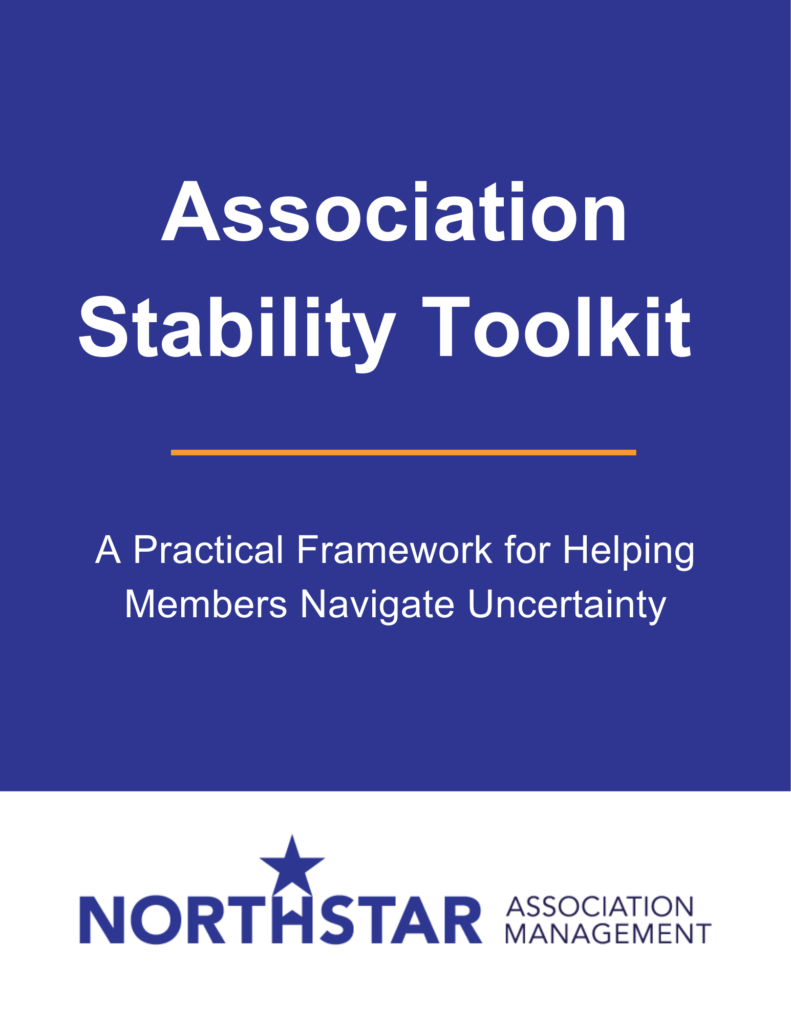
To help organizations navigate uncertainty more intentionally, NorthStar developed a simple framework: The Association Stability Toolkit.
The toolkit provides a structured way for leadership teams to assess member concerns, prioritize communication, and identify the resources members need most. It helps associations translate industry signals into clear actions — from member briefings to peer discussions and practical tools.
In moments of rapid change, even a simple framework can help leadership teams move from reacting to leading with clarity.
In times of uncertainty, associations aren’t just organizations. They are anchors for their industries.
By providing clarity, fostering community, and delivering practical resources, associations help members interpret change and move forward with confidence. When associations step into this role intentionally, they do more than support their members — they strengthen the entire ecosystem around them.
In a rapidly changing world, that leadership has never mattered more.